
Read Time: 14–16 minutes
Instead of asking “How much does a brand shoot cost?” a better question is:
What are you actually investing in—and what needs to be planned for beyond the session itself?
“What’s your budget?” is one of the first questions that comes up when you start planning a brand shoot. It’s also one of the least helpful on its own.
After more than five years of photographing brands, I’ve learned that brand shoot investment is rarely black and white. The session fee is only part of the picture. Where most people get tripped up is everything surrounding it—the decisions, the prep, and the additional costs they didn’t know to anticipate.
The goal of this post is simple: to help you accurately estimate the investment for your next suite of brand photos.
We’ll start with the photographer and work our way through the details that tend to sneak up on people—from locations and prep to vendors you might need but haven’t considered yet.
By the end, my hope is that you’ll be able to:
- understand what actually drives the cost of a brand shoot
- decide what scale of shoot fits your budget right now
- move forward with clarity, whether that means booking something big, keeping it simple, or waiting for a later season
Let’s get into it.
Finding Your Brand Photographer
Step one is selecting your photographer.
This is where most people start—and honestly, where many people stop—when budgeting for a brand shoot.
Before we talk numbers, there’s one thing I want you to hold onto:
The photographer you choose determines how usable your images are, how much prep falls on you, how distinct your brand looks in the final gallery, and how soon you’ll need to do this all over again.
A good brand photographer makes every other investment you make more effective.
Here’s why.
On larger commercial sets, everyone has a job.
A creative director. A photographer. A stylist. A producer. A lighting tech. Sometimes someone whose only job is tailoring clothes.
Brand shoots don’t work like that.
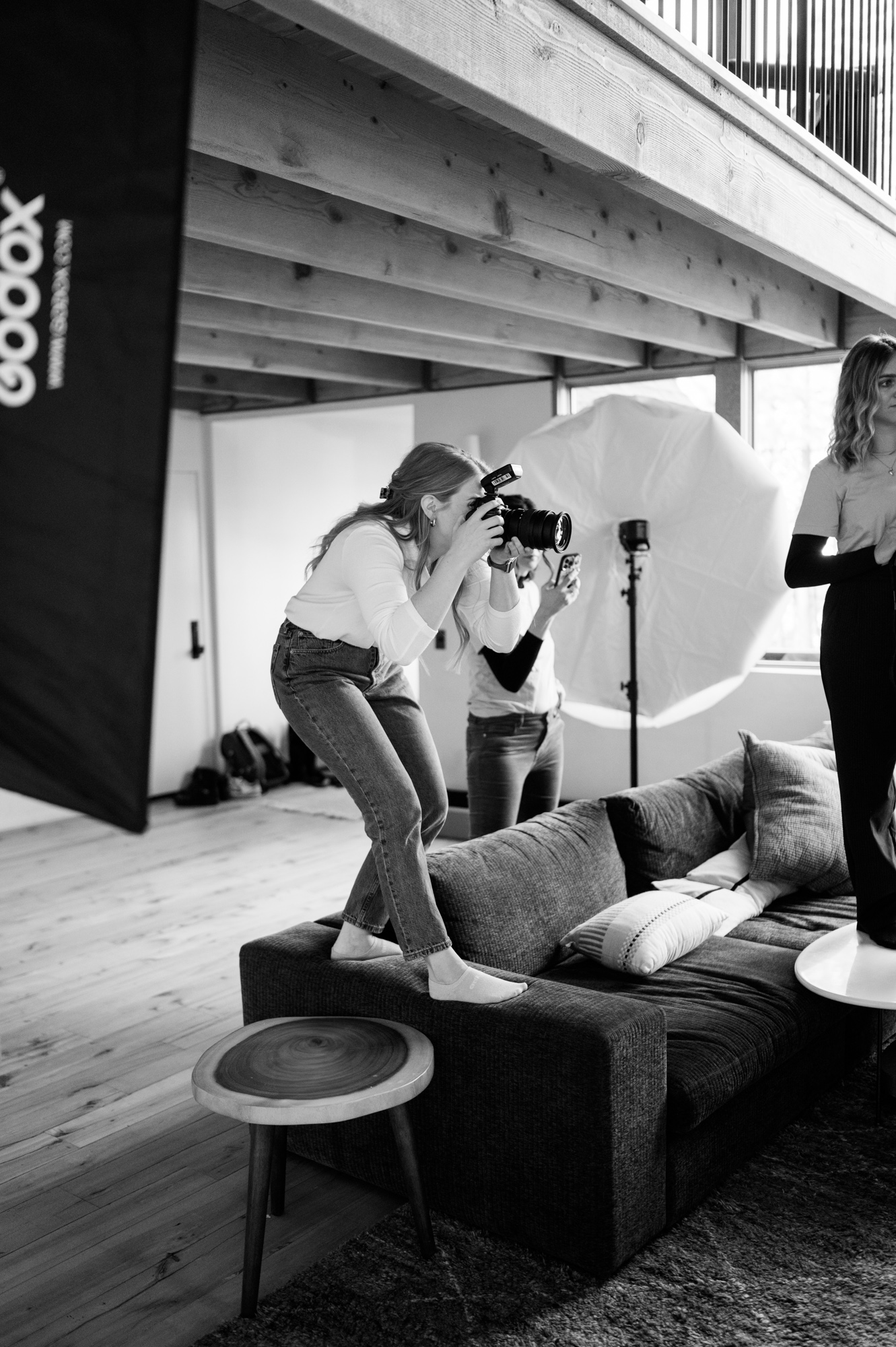
In small-business brand photography, the photographer usually fills many of those roles before shoot day and on set. Creative director. Strategist. Researcher. Lighting lead. Shot list builder. Posing guide. Production brain. Sometimes prop stylist by default.
Because someone has to connect all the dots.
That’s what you’re paying for when you hire a seasoned brand photographer: someone who can hear your vision, understand your brand, and translate all of that into images that actually work. Or, at the very least, someone who knows how to assemble the right people to make that happen.
A lot of people experience sticker shock here—and it’s usually because they don’t yet understand what they’re paying for.
You’re not just paying for brand photos. You’re paying for:
- leadership on set
- strategy behind the images
- decisions being made before shoot day so you’re not guessing in the moment
- the right [license] to actually use the images in your business afterward
Which brings me to something that needs to be said plainly:
Not all photographers are brand photographers.
Many photographers can take beautiful images. That doesn’t mean they understand how those images need to function inside a brand.
A brand photographer thinks about usage. Orientation. Framing. Variety. Longevity. Where the images will live in the wild—websites, sales pages, slide decks, social platforms—and how they’ll be reused over time.
When clients tell me about choosing the wrong photographer in the past, the feedback is almost always the same:
- they didn’t get enough usable images
- everything leaned in one direction—same pose, same framing, same look
- there was little or no help with strategy, shot lists, or location planning
- all the prep landed on their shoulders
- the images felt trendy, generic, or too similar to others in their industry
The result: they had to patch gaps themselves or book another shoot far sooner than they wanted.
So when you’re deciding how much to invest in a photographer,
the real question is how much leadership you want them to take.
If you already have the skillset to design the shoot, create a clear brief, plan locations, and confidently run the day, you can hire someone whose role is primarily execution. You may save money on the photographer—but you’ll spend it in time, research, and mental energy.
If you want a photographer who can lead you through those decisions and carry most of that weight for you, you can expect to invest somewhere in the $2,500–$7,000 range for a half- or full-day shoot. If they’re not local, travel and lodging are additional costs to plan for.
That investment may or may not include image licensing.
By default, photographers retain copyright and license images for use.
For solopreneurs and personal brands, licensing is often included. For product-based or corporate brands, licensing may be quoted separately depending on scope and usage.
There’s nuance here—region, cost of living, travel, season of business. And it’s also true that not every business needs a full-scale brand shoot.
If what you need right now is updated headshots or a small batch of content images, you may be perfectly happy working with a photographer in the $700–$1,500 range.
The key isn’t spending more. It’s choosing with discernment.
Your brand. Your goals. Your season of business. Those should lead the decision—not trends, aesthetics, or whatever’s cycling through your feed.
At the end of the day, this is a business investment.
There must be a return:
- renewed confidence that helps you show up again
- images that support a launch or a new offer
- consistency across your brand so things finally feel cohesive
Define the return you’re expecting. Then choose the photographer who can actually help you get there.


Choosing the Location Budget for Your Brand Shoot
Location is one of the easiest places to misjudge the investment in a brand shoot.
Not because locations are always expensive but because they stealthily decide how easy or hard the rest of the day becomes.
Here’s the way I think about it with clients:
The job of the location is to be the right canvas for the shoot your brand needs.
Not just something you loved at first look at the listing. Not only somewhere that looks good in photos. It has to support the brand and the type of photos you need to walk away with in your final library.
If you have to make a lot of concessions to say yes—fighting the light, hiding backgrounds, moving furniture, avoiding certain angles—that’s not inherently wrong. But it is a choice. And unless you plan for it clearly, it will show up very loudly in the final gallery.
How location decisions usually start
Most location conversations start with a few practical questions:
- Is your home an option?
- Do you have an office or studio space?
- Do you already have a location in mind?
Sometimes clients come in knowing exactly where they want to shoot. Other times, we work backwards from the brand, the goals, and the image usage. Both are normal.
Since this post is about investment, the real question here is:
What does it cost to book the right location for your shoot?
In my experience, it almost always comes down to two things:
- the type of space
- how long you need access to it
Realistic location cost ranges
Here’s what I see most often:
- Homes, offices, or spaces you already rent: often “free” to book, not always effortless to use come shoot day
- Hourly rentals (studios, private homes, styled spaces): roughly $50–$300/hr
- Overnight rentals (Airbnb/VRBO-style): typically $150+/night, often you’ll need to book more than one night to have it during prime daylight hours
- Public or outdoor locations: sometimes free, sometimes permit-based ($0–$300+)
Those numbers give you a baseline. What changes the total is everything layered on top.
The hidden costs that actually matter
Time on set
Some spaces slow a shoot down:
- dark interiors mean more time adjusting or rebuilding light
- tight rooms limit where your photographer can stand (which affects framing and variety in the gallery)
- busy backgrounds require restyling or avoiding certain angles
None of these are dealbreakers. They just mean fewer usable photos unless you plan for extra time on set.
Setup and teardown
If you’re renting by the hour, you need time before and after the shoot to unload, style, and reset the space. I often recommend at least an hour to load-in and set-up and an hour for tear down. That time expands if you’re getting hair and makeup done. Contracted shoot time should be spent creating the images, not rushing to get ready.
Styling and decor support
If a location doesn’t align with your brand, you may need props, backdrops, or small decor adjustments to make it work. Not a dealbreaker, but part of the math equation.
Permits and permissions
Public spaces, parks, and venues sometimes require permits, and sometimes restrict photography altogether. Always worth checking before you build your plan around a space.
Unpredictability
Borrowed spaces change. Public places can get busy. Furniture moves. Decor changes. Light behaves differently than expected. It doesn’t ruin a shoot entirely, but it can affect variety or the look of the shoot if your plan depends on everything going perfectly.
A reality check on “free” locations
Free locations can be amazing. They can also be deceptively expensive.
Sometimes your home, office, or a borrowed space is a perfect fit—easy win. Other times, the money you save on booking shows up as extra effort and compromise on shoot day.
Same goes for public spaces that depend on being quiet or empty to be usable. If the success of your shoot hinges on perfect timing, name that up front and know the risk going in.
The bottom line
The location can make or break both the vision for your shoot and the variety in and vibe of the final gallery.
Choose it based on what you need the images to do, not just how the space looks at first glance.
Pretty helps (it can be a lot of fun, too.
But light, space, and alignment are what actually make a location work for your brand shoot.


Wardrobe for Your Brand Shoot
Wardrobe is one of the places money disappears fastest during a brand shoot. It’s also the place that causes the most stress.
Unlike props, wardrobe doesn’t just cost dollars—it messes with your confidence if you’re not careful.
If there’s one thing that sets the tone for how you show up on camera, it’s what you’re wearing and how you feel in it. Closets are emotional places. Nothing amplifies that faster than staring at a rack of clothes and thinking, “I have nothing to wear.”
Which is usually not true. But anxiety has a way of convincing us otherwise.
When it comes to wardrobe, there are really two routes you can take:
- do it yourself, with guidance from your brand photographer
- hire a wardrobe stylist, and let someone else lead the process
Both are valid. The right choice depends on your confidence, your goals for the shoot, and how much mental energy you want to spend here.
If you’re styling yourself
If you feel fairly confident in your personal style, you’ll likely be fine going this route—with intention.
The biggest mistake I see here is buying clothes you don’t actually wear in real life. It’s easy to add to cart, plan to return later, or show up with tags still on because you’d never wear that thing outside of a shoot. (I’ve done this. Learn from me.)
The problem is that it shows. And then you’re disappointed when your final gallery doesn’t feel like you.
So here’s my honest advice: be skeptical about what you buy.
- choose better quality fabrics when you can, especially for patterns
- if you shop places like Target or Old Navy, stick to simple basics
- be cautious with trends unless they genuinely align with your brand’s personality
- spend money on pieces you’d actually integrate into your everyday wardrobe
Before you buy anything new, look in your own closet first. Revisit your brand board. Get picky.
The goal for dressing for your shoot is not about dressing for a trend—it’s about dressing for your brand, your style, and your body.
A few gut-check rules I swear by (thanks, Katherine Bignon for #2):
- don’t compromise on fit or confidence
- if you wouldn’t buy it full price, don’t buy it on sale
- if you can’t picture yourself wearing it in real life, think twice
Yes, sometimes impractical is intentional (hello, purple pantsuit)
There are times when you choose something purely for the vibe. A monochrome suit. A dramatic silhouette on a dress. Something that’s not practical day-to-day but makes sense visually for a specific concept you envision for your shoot.
That’s fine, but pleassseeee balance it.
Your wardrobe sets expectations. The way you dress communicates environment, tone, and energy. Make sure at least some of your outfits feel like a polished version of how you actually show up in your business day-to-day with clients and customers, not a costume-closet you donned for a one-time-brand-shoot occasion.
When does hiring a stylist makes sense?
If thinking about wardrobe for your shoot already makes you feel overwhelmed, hiring help can be worth every penny.
A good stylist isn’t just shopping for trends. They understand how clothing communicates, how it photographs, and how it aligns with your brand’s positioning.
This kind of support often comes with a four-figure price tag, and yes, you’ll likely invest more in clothing as well. But if you’re in a season of growing or repositioning, how you show up as the face of your brand matters.
Just be selective. A good stylist for a brand shoot isn’t only someone who has good style and can read the trends, they understand brand language and how to translate it visually.
What to budget for wardrobe
Most clients land somewhere between $200–$2,500 for wardrobe. That range can go higher if you’re working with a stylist and using the shoot as an opportunity to upgrade both your brand shoot wardrobe and your personal one.
As with everything else in this process, the right number depends on your goals, your season of business, and how much support you want.
How outfit count affects time and variety
Wardrobe doesn’t just affect how your photos look—it directly affects how your time on set gets used.
Here’s a simple rule of thumb I share with clients:
- 2 hours on set: 2–4 outfits
- 4 hours on set: 3–6 outfits
- 6+ hours on set: 6–10 outfits
More outfits can create more variety—if the shoot is planned to support it. Every outfit change takes time, and time spent changing, styling, and deciding what to wear next is time you’re not shooting.
This is where your shoot goals matter:
- if your goal is a large content library, more outfits or layered changes can make sense
- if your goal is depth and cohesion, it’s often smarter to limit outfit changes so there’s time to fully work the shot list
Outfits are a big driver of variety, but they’re not the only one. Location changes, framing, props, movement, and posing can all create variation without requiring a full wardrobe swap.
The sweet spot is choosing enough outfits to support your goals—without letting wardrobe decisions eat into the time you hired your photographer to create images.


Props
This is the most nuanced category of investment in a brand shoot.
Props aren’t just things you put in a frame—they’re how context enters the image. They tell part of the story that a person or location alone can’t.
Sometimes that looks like tools of the trade: a florist with flowers, a nurse practitioner teaching on a whiteboard, a copywriter surrounded by books and notes. Other times, props communicate values or sentiment—family photos on the wall, a hand-lettered quote you live by, a well-worn notebook that signals depth over clean-slated polish.
And sometimes, props exist purely to set the tone. They bring brand colors into the frame, give the subject something to hold, or subtly signal a message. A rotary phone. A magnifying glass. A candle. A fireplace. When chosen intentionally, these details can become visual shorthand—something people begin to associate with your brand without ever needing to see your name.
Not every prop needs to be front and center. In fact, many shouldn’t be. Background details—like bookshelves, desk items, household decor—often do more work when they’re simply there, adding context without being on-the-nose.
How much you invest here depends entirely on what you’re shooting.
If your images are primarily people- or process-focused, and your work doesn’t require much on hand, you can often get by with around $150—updating a few pieces and using tools you already own.
If you’re styling a set of stock or prop-centric images meant to function as identifying visuals for your brand, the budget naturally grows. That’s when you’re investing in things like stationery, higher-quality objects, dishes or trinkets, brand-color elements, or symbolic items tied to a message or an offer.
This is where strategy matters most.
It’s very easy to buy a mountain of cute things that could work on set. Over time, I’ve learned that a prop should earn its keep on the packing list. If it isn’t tied to a specific shot, doesn’t have a place in the background, or wasn’t chosen with a purpose in mind, it’s probably just clutter and can be marked off the shopping list.
Too many props don’t just muddy the frame—they create decision fatigue on set.
More things mean more choices, which often means less actual shooting. This is one reason having a stylist on set can be incredibly helpful. Their job is to curate, decide, and style—while the photographer focuses on lighting, framing, and creating the images.
As a general guideline, I’d say most prop budgets land somewhere between $100–$1000, depending on the scope of the shoot.
That range is wide because the needs are wide.
For example, a few summers ago I planned a second shoot for a repeat dietitian client. The concept centered on the vibrancy of life that comes from caring for your body—food as medicine. We styled a set of stock imagery for her website and social graphics using two seamless paper backdrops in her brand colors and monochromatic food sourced from the grocery store. The food itself was a one-time purchase, used specifically for that image set.


On the other end of the spectrum was a destination brand shoot in Lake Arrowhead, CA. The client was flying in and out the same day, and we brought in a wardrobe and set stylist. Because of travel logistics, many props—things like a desktop computer, matcha set, vintage phone, champagne and glassware—were purchased, styled, and later returned. This approach isn’t typical, but it’s a valid option when the shoot concept and logistics call for it.


Prop shopping can be fun.
It can be a chance to finally invest in higher-quality office or home items you’ve been eyeing but couldn’t quite justify. It’s also okay, in some cases, to buy impractical items for a single shot with the plan to return them.
The key here is clarity.
Communicate clearly what you already have on hand. Trust your photographer to help you decide what’s worth adding. And err on the side of simplicity—unless your brand truly calls for depth in the frame.
Lean shoots benefit from lean prop closets. Fully stocked prop tables are best reserved for brands with a defined visual language, broad usage needs, or content systems that require frequent variation. The depth and breadth of the shoot should always dictate how much you bring into the room.
Extra Vendors: When (and When Not) to Build a Team
Sometimes, a brand shoot calls for more than just a photographer.
If you’re making a significant investment already, it can be smart to be strategic about how you use that time on set—and in some cases, that means building a small team to support the shoot.
This doesn’t mean you need a full production crew. It means choosing support that helps the day run smoother and gets you closer to the assets you actually want to walk away with.
Depending on your goals, that team might include:
- wardrobe stylist
- set or prop stylist
- videographer
- hair and makeup artist
- production assistant
- BTS content creator
The first rule here is simple: loop your brand photographer in early.
Your photographer should know who will be on set, what roles they’re playing, and how that affects the timeline. Surprising them with an extra vendor on shoot day almost always throws the flow off—and it tends to show in the final gallery.
As we say around here: to be clear is to be kind.
Time is the real cost to consider
Every additional vendor affects the shoot day in some way. Sometimes that tradeoff is worth it. Sometimes it’s not.
Here’s how I generally think through the most common additions.
Wardrobe, set, or prop stylists ($1,000–$3,000)
Adding a stylist often saves time overall.
While your photographer is lighting, framing, and directing, a stylist is prepping outfits, resetting scenes, and thinking ahead to the next setup.
This usually translates to:
- more styled stock imagery
- better backgrounds and details
- smoother transitions between concepts
If your shoot requires depth, variety, or a lot of visual intention, this is often one of the most impactful hires you can make.
Videographers ($750–$4,000)
If you want on-brand video— like b-roll for your website, social content, or launches—a videographer can be a great addition.
Just remember: video takes time.
Videographers often work from their own shot list, bring their own gear, and need space to set up. That can mean fewer still images if the timeline isn’t planned carefully.
This doesn’t make it a bad choice—it just means you need to be honest about priorities. If video is a core goal, plan the day to support both mediums instead of trying to squeeze video into a still-only schedule.
Hair and makeup (varies by region)
If you’re not confident handling this yourself, hiring a professional can take a lot of stress off your plate.
A few things to plan for:
- time in the schedule for hair and makeup
- whether you want them on set for touch-ups (usually costs more)
- clear communication about how “done-up” you want to look
The goal isn’t to look unrecognizable as your normal self. It’s to look like a polished version of how you show up in real life.
A final word on building a team
More vendors don’t automatically mean a better shoot.
The best teams are built with intention—in service of the shoot goals, the timeline, and the assets you actually need. When everyone has a clear role and time to do it well, the day flows better and the final gallery reflects that.
At this point, you can probably see why “How much does a brand shoot cost?” is a hard question to answer in one sentence.
The real cost is the session fee plus the choices around it: how much leadership you want from your photographer, what kind of location your vision requires, how much wardrobe variety you want, how prop-heavy the shoot needs to be, and whether bringing in extra support will make the day smoother or more complex.
If you want a simple way to make a plan, start here:
- Name your goal. What are these images meant to do—support a launch, refresh your website, build a content library, reposition your brand?
- Choose your scale. Do you need a small update, a half-day, a full-day, or a multi-location and multi-day shoot?
- Budget for the hidden stuff. Location time and scale, setup, permits, wardrobe upgrades, props, and any extra vendors.
- Guard your shoot time. The more decisions you can make before shoot day, the more usable images you’ll walk away with in the final library.
And then give yourself permission to choose what fits your season.
A smaller shoot done well is far more valuable than a big shoot you rushed, guessed your way through, or overcomplicated.
Clarity is the win here. Once you can see the full picture, you can invest with intention—and actually enjoy the process.
If you read this and thought, “Oh… this actually clarified a lot,” you’ve got a couple of good next steps — depending on how hands-on you want to be.
📝 If you’re still mapping things out:
→ Start with the Photo Gap Finder.
It’ll help you pinpoint exactly where your brand photos are falling short (and what you actually need next) without guessing or over-planning. It’s low-pressure, practical, and designed to help you think like a strategist before you spend a dollar.
📷 If you’re ready to build the shoot with an expert in the room:
→ That’s what my discovery calls are for.
They’re not prim-and-proper sales calls—they’re like a working session where we talk through your goals, usage, scale, and whether a brand shoot even makes sense for you right now. If it does, we’ll sketch what it could look like. If it doesn’t, I’ll tell you that too 😉.
Either way, you don’t have to keep circling this decision all by your lonesome.
Pick the path that matches where you’re at—and let’s shift things forward for you.



Comments +