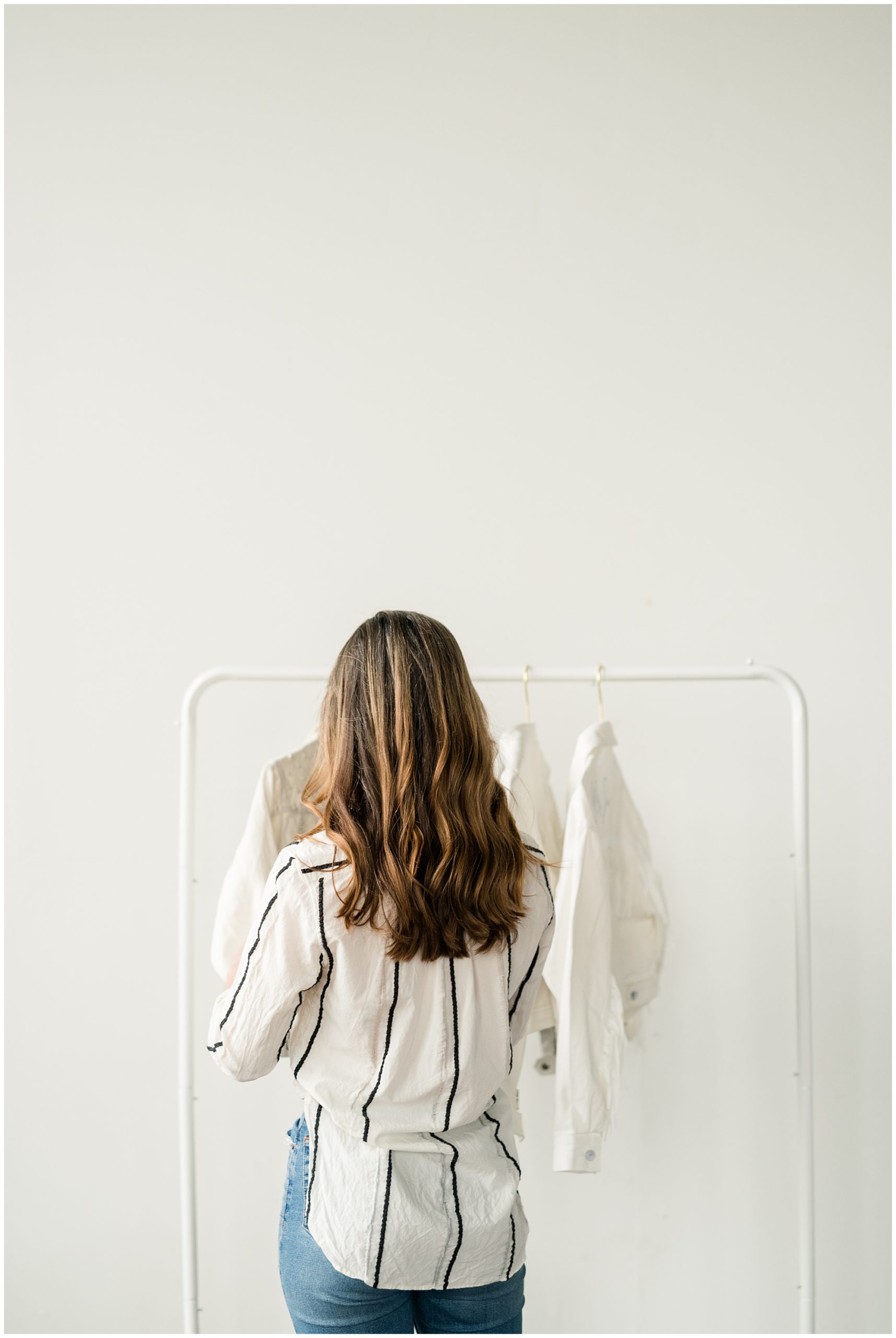

Let’s be honest: “What should I wear for my brand photoshoot?” can hit like a mini identity crisis midday, just after you locked in your shoot date.
One of the hardest parts of prepping for a shoot isn’t finding the right photographer, locations, or props—it’s standing in your closet, suddenly feeling like you’ve got nothing to wear that feels like you.
→ You scroll Pinterest for hours.
→ You add 14 things to a cart you’ll probably return.
→ You try on outfits at 10pm under overhead lighting and immediately second-guess them all.
→ You think, “Maybe I need to start from scratch…”
⏸️ Let’s pause.
You don’t need a whole new wardrobe.
You actually need a solid plan.
This post breaks down how to plan your wardrobe for a brand photoshoot in a way that feels aligned, thoughtful, and actually wearable. Because your brand deserves more than panic-shopping and trend-chasing.
The Biggest Misconception About Dressing for Your Brand Shoot
Here’s what I see constantly: people think they need to create an entirely new wardrobe for their brand shoot. That they need to lead purely with ~vibe~ and Pinterest boards, showing up in clothes they’d never actually wear in real life.
But here’s the thing: the best way to dress for your brand is to start with how you already dress for it.
If you’re a business coach who spends most days behind a laptop, yes, maybe swap the leggings for jeans. But think about what you’d wear to a networking event, an on-site client meeting, or that industry conference you’re speaking at. That’s your starting point. Not some aspirational version of yourself that only exists in a mood board.
Your brand shoot wardrobe should be a more polished spin on your everyday. Not a costume.
Look in your own closet first. Then you can invest in pieces to elevate what you’ve got. But don’t abandon who you actually are in the process.
Your Clothes Set Expectations (So Make Them Count)
Clothes make a first impression before you even say a word. They’re a reflection of your personal style, your brand’s style, and your personality all at once.
Your wardrobe can communicate that you’re a polished, expert-level coach who sits around boardroom tables with execs. Or it can show that you’re a holistic practitioner who helps people find better rhythms in their lives.
Fit, fabric, and style say a lot:
- Your values
- Your approachability
- The perception you want to lead with
Clothes bring brand colors, textures, and patterns into the frame. They can show off utility or impracticality. Communicate luxury or everyday lifestyle. The vibe of your brand, your values, and the work you do—all of this can be communicated through your style.
Breaking Down Brand Alignment by Style
Holistic/slower living brands: Organic fabrics, flowier or less structured fits, lighter accessories. Think linen button-downs, softer silhouettes, earth tones.
Polished/refined brands: Classic silhouettes, higher-end fabrics, richer colors. Structured blazers, tailored pants, timeless cuts.
Bold/creative brands: This gets more nuanced. The fit, colors, and styles have their own language—brighter palettes, unexpected patterns, statement pieces that grab attention.
When I’m evaluating wardrobe options with a client, I’m looking at their brand values and strategy first, then filtering through fit, fabric, and color. Does all of this speak to how they want to show up?
Which is why wardrobe planning isn’t something to just wing the week of your shoot. And if you have absolutely no clue how to approach this? Consider working with a stylist who understands brand strategy, not only trends or how to shop.


How to Know If Something Is Actually On-Brand
When a client asks me, “How do I know if this piece is on-brand or just something I think looks good?” here’s the framework I walk them through:
The Litmus Test:
1. Does it align with how you want to be perceived?
A holistic brand would look out of place in shiny fabrics and super structured fits. A corporate consultant would look off in bohemian florals and unstructured linen.
2. Would you get tired of this piece in a year?
Especially for pieces you’re buying new—will you still love it enough as a human to wear it again? Or are you just buying it for the shoot?
3. Would you wait a whole year to invest in it?
If you found it on sale and wouldn’t buy it full price, you probably like the price more than the item. Skip it.
4. Sleep on it.
Sometimes I decide on something and then make myself come back in 24-48 hours before making my final decision. This ensures it’s not just a 10pm choice I thought looked good in the mirror.
5. Send it to your photographer or a trusted friend.
If you really don’t know, get a second opinion from someone who knows your brand and style.
Build Around High-Quality Basics That Photograph Well
Your base layer = your best ally.
Here’s what I pull for myself and recommend to clients:
✔️ Well-fitting jeans (this is different for everyone, so I can’t give real specs)
✔️ Neutral tops in whites, creams, or grays
✔️ Layering pieces like structured blazers, sweaters, or jackets that add visual interest
✔️ Shoes that are clean, polished, and comfortable enough to walk around freely on set
→ Pro tip: Choose pieces you’d actually wear again. If you wouldn’t buy it full price, or wouldn’t wear it outside of this shoot…skip it. (Learned that one the hard way.)
But Are You Even a Blazer Brand?
Blazers are the token choice for business owners. But are you actually a blazer brand? Or do you think it just makes you look professional because you saw other people wearing them in their photos?
If you are a blazer brand, this will be helpful.
When a client is standing in their closet with 5 blazers that all seem “fine”, here’s how I help them choose which 1-3 to bring on set:
Ask yourself:
- Does the fabric photograph well, or is it super synthetic and shiny?
- Does it align with your brand colors?
- Would you actually show up to something wearing this in real life?
I love the idea of blazers. But they don’t always align with my brand, and they’re not practical because they’re tight in my shoulders. I’ve worn them in my own brand photos and at speaking gigs, but that’s really it. Lately, I’ve basically eradicated them from my wardrobe (except this vintage Saks 5th Ave tweed number that I thrifted for $5, still trying to decide if that one stays).
All in all. Don’t force a piece just because it seems “professional.”
And please, I beg you: iron or steam your clothes ahead of time.
Wrinkles on camera = a missed opportunity for polish.
Add Personality With Strategy
Your “personality pieces” are the spice in the recipe—but a little goes a long way.
Think:
- A colorful blazer or jumpsuit in a brand hue
- A standout accessory you actually wear regularly
- A graphic tee that says something without saying something
- The patterned skirt you always reach when heading to a networking event
A personality piece is a chance to add in some color or fun to your wardrobe selections, without overdoing it. It can also be something that tells a bit of your story.
I have a client who has a bolder personality but her brand tones are a bit more on the tame, colorful side. So, one of the practical ways we layered in her personality was there a few bolder blazer options contrasted with complementary colored bright paper backdrops. It was a super fun choice that worked really well for her graphics and website.
The big takeaway here is to be intentional with these pieces. Align them with your brand or your story or a fun nod to your personal style, and then rock it!
My Wardrobe Regrets (So You Can Avoid Them)
🎩 My era of hats has come back to haunt me.
I used to say “add a personality piece”—which is still great advice. But my token personality piece was a wide-brimmed, felt Gigi Pip hat that I adored at the time. Now? It ages my brand significantly. I also didn’t always pair it well. Take my sweater/straw hat combination, for example. Or my blazer, mules, and boho hat look that screams 2019-2021 millennial aesthetic (I’m not even technically a millennial).
The lesson: Make sure your personality pieces feel timeless enough to still love a year from now.
I’ve also worn styles and fits I was still getting used to during shoots. New jean styles rotate constantly. But make sure you love yourself in them from all angles before committing to them in a full brand shoot. I did not do this in my cropped wide-leg jean era. And I bought things and wore them with tags on to return. There are lots of images I didn’t 100% love in the end because of how my outfit choices photographed.
Don’t be like me. Be 100% committed to what you want to wear in frame.
What Not to Wear for a Brand Shoot
❌ Tiny patterns – Stripes, dots, or checks smaller than ¼” can cause moiré (weird wavy lines in digital images). This is especially true in full-body or pulled-back lifestyle shots.
❌ Fits you’re unsure about – If you don’t love how you look from every angle, it’ll show in the final images.
❌ Super trendy pieces – Fast fashion timestamps your brand and can make images age quickly.
❌ Loud logos or obvious brands – They can easily distract and accidentally look less polished. And to be honest, fit and quality tend to communicate refinement better than a brand logo will.
❌ *Clothes you plan to return – Don’t shoot in pieces you don’t actually like enough to keep. You’ll regret it when your gallery arrives.
*My only caveat to this advice is for those of you balling on a budget. Sometimes there are pieces you love that you wish you could keep, but wisdom says otherwise. To you I say, choose wisely. Don’t go overboard and buy a lot of things you plan to return, but if there’s a specific dress that is totally on brand but has a few too many $$$ to justify keeping it forever, then you might get a pass here.
The Truth About Bold Colors and Patterns
There aren’t any specific colors I tell people to totally avoid. Your brand needs to show up in its color palette. But here’s what you need to know about louder patterns or colors: they’re more recognizable.
That’s often the whole point—to grab attention and layer in personality. But because of that “loudness,” people recognize them more easily, which can mean you get tired of an image quicker.
So be mindful. If your whole shoot is that loud, bright color because that’s your brand palette? Roll with it. But consider counterbalancing with some practical, more everyday options.
For some brands (like mine), that looks like basics and neutrals.
For others, you might achieve that with the fit or style of the piece versus the color.
What About Accessories?
Align accessories with your normal wear.
Jewelry: If you’re a jewelry person, be a jewelry person and choose pieces per outfit. If you’re not, don’t force it.
Shoes: Align those with the occasion of the outfit and pick them per outfit.
Bags, hats, scarves: Add these lightly and only when they make sense.
If you’re like my friend Charla who is a gardener from Texas, scarves and hats are her uniform in the garden to protect her from the sun. An assortment of those in her brand shoot wardrobe would be expected. But for me as a brand photographer? It wouldn’t make sense for me to have lots of them.
Bags can be fun props when you’re shooting specific concepts where they make sense. Say you have a favorite Italian leather tote that you throw your laptop in for travel days or coffeeshop workdays. Great add to the list if you’re photographing some on-the-go lifestyle shots. But if it doesn’t make sense with concepts on the shot list, skip it.
What Does “Professional But Approachable” Actually Look Like?
This is the sweet spot a lot of my clients are trying to hit. And it’s more about intentional styling choices than one “right” outfit.
Let’s play a little bit with association here so you can see what I mean:
Structure and flow:
Buttoned up and polished options with more structure = more corporate/professional.
Flowier cuts, rolled-up sleeves, open buttons = more approachable/warm.
Bottoms choice:
Jeans = casual and approachable.
Black pants or dress pants = polished and professional.
Color and pattern:
There are friendly colors and patterns (softer tones, organic prints) vs. refined and richer colors (deeper jewel tones, classic patterns). Choose ones that align with the perception you want to lead with.
Reality check:
It’s easy to want to look your absolute best on a brand shoot—polished is smart. But sometimes too put together can bite you. Your brand photos as the face of a personal brand set up an expectation for people of how you are. They’re making a first impression.
If all your photos have lots of glam makeup and outfits that feel super staged, it creates a mirage effect. I personally like to show up on set like how I am in real life with a touch more polish.
And yes, posing and expression on set matter here too. Clothing isn’t the only layer to this conversation, but it’s an unspoken factor that does heavy lifting.
Curate Full Looks
Here’s the most common on-set mistake I see:
Clients show up with a pile of great clothes…but no actual outfits.
🙅🏼 Outfits still in shopping bags, tags on, nothing paired = a boatload of stress and decision paralysis
I’ve spent 20+ minutes of actual shooting time sorting through and selecting outfits for a client and their team before. That time was supposed to be spent creating the images that filled our shot list.
Instead of expediting decision fatigue on shoot day, choose to plan out all your outfits in advance AND then send them to your photographer so they know what you’re bringing.
Here’s my go-to workflow for choosing outfit pairings for your shoot:
- Lay all your outfit contenders on the bed. No need for organization yet.
- Make two piles: YES and MAYBE. Start weeding out the things you’re actually excited about versus the ones you’re lukewarm on.
- Start creating full looks from head to toe: Top, bottom, layer, shoes, accessories. Lay them out on the floor in complete outfit piles.
- Try on every full outfit and snap a mirror selfie. Do a final check. If you’re second-guessing it now, you’ll likely regret it on shoot day or when your gallery arrives.
- Save them in an album and send to your photographer.

This preps you mentally and saves time on shoot day. Your photographer can also give you feedback on what will photograph well.
How Many Outfits Should You Bring to a Brand Photoshoot?
Here’s my rule of thumb:
| Shoot Length | Outfits |
|---|---|
| 2 Hours | 2–4 |
| 4 Hours | 3–6 |
| 6+ Hours | 6–10 |
More content = more outfit changes.
If you’re trying to build a big content library for future posts, emails, and social, plan extra layers or fast swaps.
More styling = fewer, stronger looks.
If you’re focused on deep storytelling or editorial-quality images, limit changes so you have time to finesse the details.
Should You Hire a Stylist for Your Brand Photoshoot?
If your palms are sweating and you’re still staring blankly at your closet after reading this post—hire a stylist. 🫶🏼
When to Call a Stylist:
✔️ If even the thought of planning your outfits scares you
✔️ If you don’t have time to shop or search online
✔️ If you want to refine the way you show up in your brand on the daily and elevate your style in general
✔️ If you’re totally lost in the clothing department
✔️ If you want to raise the bar of your brand shoot and know that planning your own wardrobe might be a sticking point
✔️ If you don’t feel your best in your body but want to show up comfortable and confident in front of the camera
Not everyone needs a stylist. Sometimes your personal style is on lock and you can breeze right into your shoot choosing your own outfits. And sometimes it really is a budget thing and you need to DIY it this time around—only you can discern that.
But if you’re in a season where you have the margin in your budget and can hire someone, it’s a wise investment in how you show up as the face of your brand. Wardrobe is one of the most practical ways to do that.
I always recommend Katherine Bignon to clients who want concierge-level help planning outfits that embody their brand. She understands how to style for the camera and for brand strategy. Yes—it’s often a four-figure investment. But if you’re scaling and stepping into more visibility, it’s worth every penny.
Dress for Your Brand. Not the Trend Cycles.
Your brand wardrobe gets to be a merging point for your brand’s style and your own personality. It’s where you get to show up as yourself and as the face of your brand.
That shouldn’t be totally dictated by what Target decides to sell this season or what Instagram ads are feeding you.
Your brand is defined by your story, values, and strengths, then filtered through the lives and preferences of your ideal audience to create connections and solve their problems. You want your wardrobe to embody that so your people feel connected to you before they even realize it.
Especially in this economy when trust and rapport are what determine sales—we’re all skeptical right now. Do your earnest best to be yourself in front of the camera in a way that represents your brand well.
Don’t just wear a costume for a cute shoot that feels super cool but doesn’t actually connect you to the people you’re trying to serve.
The Bottom Line
Clothes make a first impression—and they carry your brand story.
Your wardrobe doesn’t just say “I’m stylish.” It says:
- I’m polished and detail-oriented.
- I’m warm, approachable, and relatable.
- I’m bold and visionary.
- I’m rooted and trustworthy.
Fit, fabric, and color communicate more than you think. Your clothes are your first line of brand communication in a visual medium. Let them carry some of the weight for you—so your audience feels your brand before they read a single word.
And if you remember nothing else:
Wear what makes you feel like the most you version of yourself. Confidence photographs real well.
Now, onward.
Bookmark this post for when you’re planning your shoot. And if you have questions as you’re prepping? DM me on Instagram—I love talking through this stuff with people.
Have fun planning your wardrobe for your next brand shoot!



Comments +